Overall picture: cautious, uneven recovery
Retail is bouncing back from the 2022 economic crisis, but the recovery is being complicated by a fresh inflation spike and a shifting tax/compliance landscape. Fundamentals like credit growth and remittances are improving, and the industry body is publicly optimistic about a consumer rebound – but this optimism is landing right as an energy-driven inflation spike threatens to squeeze real household spending power again.
1. Macroeconomic Performance and Consumption Trends
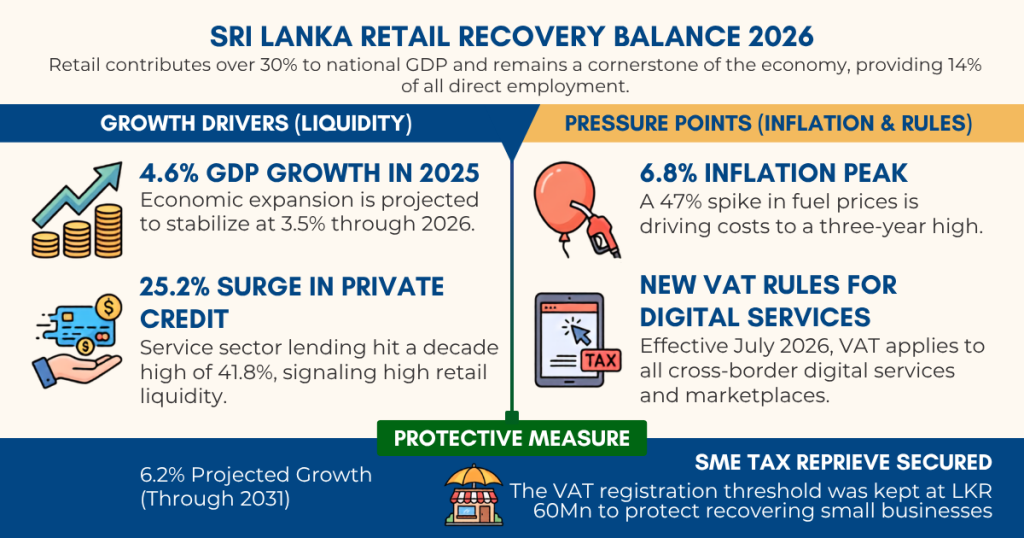
- The World Bank’s Sri Lanka Development Update projected 4.6% growth in 2025, slowing to 3.5% in 2026, supported by a modest industry rebound and steady services growth – but flagged the recovery as “uneven and incomplete” (World Bank, October 2025).
- Private sector credit growth accelerated sharply in 2025 – 25.2% by end-2025 versus 10.7% by end-2024 – expanding total outstanding credit to 31.2% of GDP, per the ADB’s April 2026 Asian Development Outlook. Services sector lending surged 41.8% (its highest in over a decade), a strong signal for retail-linked financing.
- Consumer spending (Central Bank data via Trading Economics) rose to LKR 20,542,233 million in 2024 from LKR 19,411,969 million in 2023, continuing a gradual recovery trend.
2. Shifts in Consumer Behavior
Direct data on Sri Lankan retail consumer behavior in 2026 is limited in what’s been retrieved so far. What the sources do indicate:
- The Sri Lanka Retail Association (SLRA) explicitly frames the industry as navigating “a changing business environment shaped by inflation, digitalisation and evolving consumer behaviour” (Daily Mirror, July 2, 2026).
- SLRA’s 2026 forum theme – “Retail Without Boundaries – Building the Next Growth Engine” – reflects an expectation that household demand will gradually recover and that consumer expectations are evolving alongside technology adoption (Daily Mirror).
- Rising inflation (see Section 6) is a headwind likely to push cautious, essentials-first spending, though no source yet quantifies this shift directly for Sri Lanka specifically.
3. Performance of Modern Trade and Retailers
- The retail sector accounts for over 30% of national GDP and provides 14% of direct employment, with over 10% of Sri Lankan households depending on retail jobs (LNW Lanka News Web).
- The SLRA – representing organised/modern retail since its founding in 2015 – describes retail as “one of the most dynamic sectors of the Sri Lankan economy” (Daily Mirror).
- The Sri Lankan Retail Industry Market is projected to grow at a CAGR of approximately 6.2% from 2025 to 2031 (6Wresearch market report).
4. Digital Transformation and E-commerce
- Digital transformation is explicitly named by the SLRA as one of the forces reshaping the retail industry alongside inflation and evolving consumer behaviour (Daily Mirror, July 2, 2026).
- On the regulatory side, digital commerce is being formally drawn into the tax net: VAT now applies to cross-border digital services from non-resident providers (streaming, cloud/SaaS, apps, online marketplaces, ride-hailing, and accommodation platforms), effective July 1, 2026, with a threshold of LKR 60 million in the preceding 12 months
- This VAT extension is Sri Lanka aligning with more than 120 countries that already tax non-resident digital services, per vatcalc.com’s coverage of the Cabinet’s implementation timeline.
5. Macro Backdrop Retail Is Riding On
- Sri Lanka’s economy continues to recover from its worst financial crisis in decades, with private sector credit growth accelerating and remittance inflows strengthening (SLRA, via Daily Mirror).
- The World Bank’s David Sislen (Division Director for Maldives, Nepal, and Sri Lanka) noted: “While Sri Lanka’s recent economic progress is encouraging, the recovery is uneven and incomplete” (World Bank, October 2025).
- Credit conditions have improved meaningfully – a good leading indicator for retail investment and consumer financing – per the ADB’s April 2026 outlook.
- A new five-year Country Partnership Framework (CPF) between Sri Lanka and the World Bank Group, launched April 2026, aims to support continued recovery, a 7% medium-term growth target, job creation, easier business regulations, modernised trade processes, and doubling annual export earnings to $36 billion by 2030 (All India Radio/newsonair.gov.in).
6. The Inflation Headwind
- Headline inflation (CCPI) rose to a three-year high of 6.8% in June 2026, near the Central Bank’s upper target of 7%, up from 5.5% in May 2026 (EconomyNext; Central Bank of Sri Lanka).
- This is driven by an external shock, not domestic demand overheating: the government raised fuel prices by around 47% following a supply shortage tied to Middle East escalation and higher global oil prices.
- Non-Food inflation (Y-o-Y) accelerated to 8.4% in June from 7.8% in May; Food inflation accelerated to 3.6% from 0.9% (Central Bank of Sri Lanka).
- On a month-on-month basis, the CCPI rose 2.1% in June 2026, driven largely by fish and vegetable prices in the food category and transport in the non-food category.
- The Central Bank raised its Overnight Policy Rate by 100 basis points in the month of May 2026 to curb demand-driven inflation, and analysts expect further tightening may be needed (EconomyNext).
7. Retail Sector’s Own Read (Early July 2026)
- The SLRA’s renewed optimism comes as Sri Lanka’s economy recovers from its financial crisis in decades, with private credit growth accelerating and remittances strengthening, “although inflation has begun to rise again following recent energy price increases” (Daily Mirror, July 2, 2026).
- Newly elected SLRA President Infiyaz M. Ali: “Retail continues to be one of the most dynamic sectors of the Sri Lankan economy… As consumer expectations evolve and technology reshapes the industry, the role of SLRA is to create opportunities for knowledge sharing, collaboration, and collective action.”
- Trade Minister Wasantha Samarasinghe, attending the SLRA event, described retail as a key contributor to economic development, employment generation, and consumer welfare, calling for stronger public-private collaboration to improve competitiveness.
- The SLRA announced its flagship “Sri Lanka Retail Forum 2026” under the theme “Retail Without Boundaries – Building the Next Growth Engine,” reflecting expectations that retail could play a larger role in supporting growth as household demand gradually recovers.
- Retailers are seeking closer engagement with policymakers as the industry navigates inflation, digitalisation, and evolving consumer behaviour.
8. SME Compliance and Retail Taxation Shifts
A VAT Amendment Bill (Gazette issued April 29, 2026) introduced sweeping changes to Sri Lanka’s indirect tax regime, with most provisions taking effect July 1, 2026 (Daily FT, citing KPMG Sri Lanka analysis):
- VAT extended to cross-border digital services from non-resident providers, with B2B transactions handled via reverse-charge.
- VAT on financial services raised from 18% to 20.5%, increasing costs for banks and insurers that may pass through to retail-adjacent lending and card fees.
- Apparel-linked services gained zero-rating; Port City business exemptions retained.
- A standardised VAT invoice format became mandatory for all VAT-registered persons from July 1, 2026 – including structured serial numbering, detailed purchaser identification fields, and standardised data fields (Daily FT, “VAT Invoice Reform 2026: A necessary step forward but are SMEs ready?”).
The SME-specific threshold cut was reversed – a notable political U-turn
The original Bill would have cut the VAT registration threshold from Rs. 60 million to Rs. 36 million annual turnover, effective July 1, 2026 – pulling many more SMEs and small retailers into the VAT net. The government dropped this specific change in a Parliament announcement on June 23, 2026 (EconomyNext):
- Had it proceeded, newly registered small retailers would have needed to maintain detailed records, issue VAT invoices, adopt POS machines, file regular returns, and remit tax – administrative costs estimated at 5–15% of turnover for smaller players, since many SMEs run on manual or basic accounting systems.
- SME associations, chambers of commerce, and opposition parties lobbied against it, warning of job losses, forced business fragmentation, or firms retreating into the informal economy.
- A Ministry of Finance official (quoted in The Morning) confirmed the Rs. 60 million threshold is being retained specifically because of “the challenges faced by Small and Medium-sized Enterprises (SMEs), which were still in the process of recovering.”
- Economists flagged this as a fiscal cost – a budgeted revenue measure not implemented – with the government instead leaning on improved tax administration and digitalisation (e.g., the digital services VAT) to hit revenue targets.
Net effect for retail
- Larger, already-VAT-registered retailers and wholesalers face immediate compliance work: new invoice formats, POS integration, and tighter enforcement/penalties.
- Smaller retailers got a reprieve from being newly dragged into the VAT net – a meaningful, if temporary, win for the SME segment, though the underlying pressure to broaden the tax base (an IMF-aligned goal) hasn’t gone away and could resurface in a future budget.
- The reform direction (e-invoicing, formalisation, POS mandates) signals a longer-term shift toward tighter retail sector oversight, paced to avoid destabilising SMEs mid-recovery.
Sources
- Daily Mirror – “Retailers eye consumer rebound, seek stronger policy voice” (July 2, 2026): https://www.dailymirror.lk/business-news/Retailers-eye-consumer-rebound-seek-stronger-policy-voice/273-344426
- EconomyNext – “Sri Lanka inflation rise to 3-year high in June 2026” (June 30, 2026): https://economynext.com/sri-lanka-inflation-rise-to-3-year-high-in-june-2026-to-near-cbs-upper-target-band-276825/
- Central Bank of Sri Lanka – “CCPI-based headline inflation accelerated further in June 2026”: https://www.cbsl.gov.lk/en/news/ccpi-inflation-june-2026
- Central Bank of Sri Lanka – Inflation press releases index: https://www.cbsl.gov.lk/en/press/press-releases/inflation
- Asian Development Bank – Asian Development Outlook, April 2026 (Sri Lanka chapter): https://www.adb.org/sites/default/files/publication/1135881/sri-ado-april-2026.pdf
- World Bank – “Sri Lanka’s Economic Recovery Remains Incomplete as Key Challenges Remain” (October 7, 2025): https://www.worldbank.org/en/news/press-release/2025/10/07/sri-lanka-s-economic-recovery-remains-incomplete-as-key-challenges-remain
- LNW Lanka News Web – “Sri Lanka’s Retail Sector Poised for Recovery amid Economic Stabilization”: https://lankanewsweb.net/archives/60790/sri-lankas-retail-sector-poised-for-recovery-amid-economic-stabilization/
- 6Wresearch – “Sri Lanka Retail Industry Market | Size, Share & Volume 2031”: https://www.6wresearch.com/industry-report/sri-lanka-retail-industry-market-outlook
- Trading Economics – Sri Lanka Consumer Spending: https://tradingeconomics.com/sri-lanka/consumer-spending
- All India Radio (newsonair.gov.in) – “Sri Lanka & World Bank Group launch new partnership to boost private investment & support economic recovery” (April 3, 2026): https://www.newsonair.gov.in/sri-lanka-world-bank-group-launch-new-partnership-to-boost-private-investment-support-economic-recovery
- Daily FT – “Govt. widens VAT net: new Bill cuts threshold, taxes digital services, raises financial sector levy” (May 4, 2026): https://www.ft.lk/business/Govt-widens-VAT-net-new-Bill-cuts-threshold-taxes-digital-services-raises-financial-sector-levy/34-791395
- Daily FT – “VAT Invoice Reform 2026: A necessary step forward but are SMEs ready?”: https://www.ft.lk/columns/VAT-Invoice-Reform-2026-A-necessary-step-forward-but-are-SMEs-ready/4-792457
- EconomyNext – “EXPLAINER: Sri Lanka govt shelves VAT threshold reduction on political, economic U-turn”: https://economynext.com/explainer-sri-lanka-govt-shelves-vat-threshold-reduction-on-political-economic-u-turn-276354/
- The Morning – “Implications of keeping the VAT threshold unchanged”: https://www.themorning.lk/articles/S9zkAvbqxOr8Yw4Dekv7
- Conventus Law / Desaram – “Sri Lanka VAT Changes 2026: Key Updates Businesses Must Know”: https://www.desaram.com/sri-lanka-vat-changes-2026-key-updates-businesses-must-know/
- vatcalc.com – “Sri Lanka VAT digital services delay to July 2026”: https://www.vatcalc.com/sri-lanka/sri-lanka-vat-on-digital-services-proposals/
- Sri Lanka: VAT Amendment Act introduces digital services VAT and compliance changes:
https://www.globalvatcompliance.com/globalvatnews/sri-lanka-digital-vat-2026/